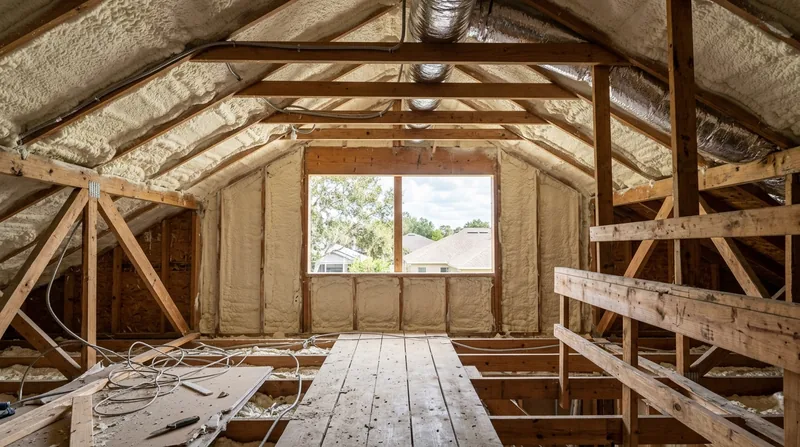




Open Cell Spray Foam Insulation in Orlando addresses the core cooling challenge facing most homes in the region: attics that pull in hot, humid air for nine months of the year and leak that conditioned air straight back out through the ceiling plane. Orlando sits in IECC climate zone 2A, where long summers and year-round moisture drive cooling costs higher than the insulation itself, and the vented attics common in subdivisions from Lake Nona to Winter Garden are the weak point in almost every house. Open cell foam fills rafter cavities and wall spaces to slow that heat and humidity transfer, works well in the vented attic runs that dominate newer construction, and costs less per board foot than closed cell alternatives. We have been doing this work since 2010, and we know exactly how moisture moves through the attic plane in this climate and how to seal it without trapping water inside the cavity. Call us at (689) 219-8153 for a free written estimate, or read on to understand why open cell foam makes sense for many Orlando homes.
Why Open Cell Spray Foam Matters in Orlando's Hot, Humid Climate
The problem in Orlando is not winter heat loss. It is summer heat gain and moisture ingress through the attic deck and ceiling plane. Block homes in College Park and Baldwin Park were built with masonry walls and vented attics that were never sealed tight, while newer frame construction toward Winter Garden and Lake Nona stacks two-story layouts with rooms over garages and long duct runs through the attic. In both cases, the vented attic pulls in outside air at 90+ degrees and 70+ percent humidity, and that air works through the ceiling into the living space below. Open cell foam stops that transfer by filling the rafter cavity completely, and because it is vapor-permeable, it allows any moisture that does enter the cavity to dry back out rather than trap it against the roof deck.
- Open cell foam fills rafter cavities from soffit to ridge, eliminating the vented attic air path that dominates cooling losses in Orlando homes.
- The material is vapor-permeable, so moisture can dry in both directions if the roof deck gets wet from rain or condensation during humid mornings.
- Installation is faster and less expensive than closed cell foam, making it the right choice for straightforward attic work in homes without standing moisture or active roof leaks.
- Open cell foam works equally well in wall cavities of older block homes, filling the thermal break between the masonry exterior and the interior conditioned space.
These advantages add up to a job that costs less and performs well in the specific climate and construction style of Greater Orlando.
Key info: Orlando's attic failure is driven by humidity and heat ingress, not winter cold. Vented attics in subdivisions like Winter Garden and Lake Nona pull in 90-degree air for nine months straight. Open cell foam seals that path without trapping moisture, making it the standard choice for most Orlando attic retrofits.
For more detail on how to seal an attic properly, see our guide to attic spray foam insulation in Orlando.
How We Install Open Cell Spray Foam: The Orlando Process
Open cell foam installation starts with a site survey to confirm the attic is dry and the roof deck has no active leaks. We measure rafter spacing, note any existing insulation that needs removal, and identify air sealing points around ductwork, electrical chases, and the perimeter. Once we confirm the substrate is sound and dry, we bring in the spray rig, set up mechanical ventilation, and spray the foam in a series of passes to build up the target thickness without exceeding the manufacturer's per-pass limits. The foam cures as we work, and we establish a re-entry window of 24 to 48 hours before the homeowner can use the space.
- We inspect the attic for active moisture, roof leaks, or contamination before quoting or scheduling work.
- We remove any failed or settled fiberglass insulation and vacuum the deck clean, so the foam bonds to a solid substrate.
- We run mechanical ventilation during the entire spray and cure period to manage off-gassing and ensure safe air quality.
- We spray in controlled passes, measuring thickness with depth gauges to hit the target R-value without over-spraying or creating voids.
- We seal all rim joists, band joists, and air leaks around ductwork and electrical penetrations as part of the same job.
The whole process is straightforward because open cell foam is forgiving: it fills cavities completely, cures predictably, and does not require the precision of closed cell work on metal buildings or condensation-sensitive surfaces.
Example: A Winter Park home with a 1,200 sq ft attic and R-19 fiberglass settled to R-6 takes about two days: one day to remove the old insulation and prep, one day to spray and cure. The homeowner is back in the attic by day three. The same job in a newer Thornton Park home with vented attic and no prior insulation might take one day of spray work plus a day of cure.
See our air sealing service page for details on how we seal the perimeter and penetrations around your insulation.
Open Cell Spray Foam Installation Methods and Applications
| Approach | Description | Best for |
|---|---|---|
| Attic rafter cavity fill | Foam sprayed into the cavity between rafters from soffit to ridge, creating a continuous thermal and air barrier against the roof deck. | Vented attics in newer subdivisions like Winter Garden and Lake Nona; homes with rooms over garages and long duct runs. |
| Wall cavity retrofit (injection) | Foam injected into closed wall cavities through small holes, filling the space between the exterior masonry or frame and the interior drywall without demolition. | Block homes in Baldwin Park, College Park, and Thornton Park where masonry walls have little thermal resistance and cannot be opened. |
| Rim and band joist sealing | Foam sprayed into the rim joist cavity at the perimeter where the house sits on the slab, blocking air infiltration at the foundation line. | All Orlando homes on slab on grade; critical in older block construction where the perimeter is a major air leak path. |
| Garage ceiling and wall fill | Foam sprayed into garage ceilings and exterior walls to separate the unconditioned garage from the living space above and beside it. | Rooms over garages common in newer subdivisions; reduces cooling loss through the garage ceiling and summer heat gain into the living space. |
Each method uses the same open cell foam product but targets a different part of the house. The choice depends on where the biggest heat and moisture leak is at your address.
Open Cell Spray Foam Insulation Cost in Orlando: What to Expect
Open cell spray foam in Orlando typically costs starting at $0.55 per board foot, with most attic jobs ranging from $0.55 to $0.85 per board foot depending on access, rafter spacing, and the amount of existing insulation that needs removal. A 1,200 square foot attic sprayed to R-30 (about 5.5 inches of open cell foam) falls in the $3,500 to $5,500 range before any removal work. Wall injection foam in older block homes costs more per board foot because it requires drilling and injecting into a closed cavity, but the total square footage is smaller. Rim joist sealing and garage ceiling foam are smaller jobs, typically $800 to $1,500 each.
The biggest variables are the amount of old insulation to remove, the ease of access to the attic or wall cavity, and whether the substrate is clean and dry. A straightforward top-up of a sound attic with minimal existing fiberglass costs less than a full removal and re-spray. Roof leaks, active moisture, or contamination require fixing the source before we spray, which adds cost and timeline but is non-negotiable.
Get a free written estimate with R-value and thickness specifications from us by calling (689) 219-8153. We measure the job on site, confirm the substrate condition, and give you a firm quote before any work starts. See our pricing page for more detail on what moves the cost up or down.
What to Look for When Hiring an Open Cell Spray Foam Contractor Near Me in Orlando
The spray foam industry has two kinds of bad actors: rig-and-run crews from out of state who spray in an afternoon and disappear when the smell will not go away, and national franchises that mark up the price and subcontract the work to the lowest bidder. The local independent contractor is positioned against both, and the way to verify that is to ask for specifics on every estimate you get.
Start by asking any contractor for a written estimate that includes the R-value, the thickness in inches, and the square footage being sprayed. If the estimate does not have these numbers, walk away. Ask whether they run mechanical ventilation during the spray and cure, and what the re-entry window is. Any contractor who promises immediate re-entry or says the smell will not happen is either lying or cutting corners on ventilation. Verify that they carry liability insurance and can show you a current certificate. Ask for references from three recent jobs in Orlando or the surrounding area, and call them. Ask whether the job stayed on schedule, whether the contractor was reachable after the work was done, and whether there were any smell or curing issues.
Permitting for attic insulation varies by city in Greater Orlando. Some cities require a permit for spray foam work, others do not. The contractor should know what applies at your address and help you navigate it, but the final call is with your local building department. Check the city or county website for your address and call the building department if you are not sure. HOA rules rarely touch insulation work, but if you are in a master-planned community, verify that the HOA has no restrictions on exterior work if your job involves the outside of the house.
We are fully insured, have been in business since 2010, and carry a one-year workmanship warranty on every job. Call us at (689) 219-8153 for a free estimate, and we will give you the specifics in writing.
Open Cell Spray Foam Insulation in Orlando: Pricing Guide
| Service | Price | Details |
|---|---|---|
| Attic open cell foam (typical 1,200 sq ft home) | Starting at $0.55/board ft | R-30 coverage, includes prep, removal of settled fiberglass, mechanical ventilation, and rim joist sealing at perimeter |
| Wall cavity injection (retrofit in block homes) | Starting at $0.75/board ft | Drilling and injecting closed wall cavities without demolition, common in older Baldwin Park and College Park homes |
| Garage ceiling and wall fill | Starting at $0.65/board ft | Separating unconditioned garage from living space above, sized to room dimensions and access points |
| Rim and band joist sealing (perimeter) | Starting at $600 to $1,200 | Air sealing at the foundation line where house sits on slab, sized to linear feet of foundation and cavity depth |
| Insulation removal and disposal | Included | in the board foot price for full attic retrofits; separate quote for removal-only jobs or hazardous materials |
| Free written estimate | No obligation | Response within 24 hours at (689) 219-8153, includes R-value, thickness, and square footage specifications |
Indicative pricing, the exact cost depends on square footage, finish, and site access. Free personalized estimate within 24h at (689) 219-8153.


