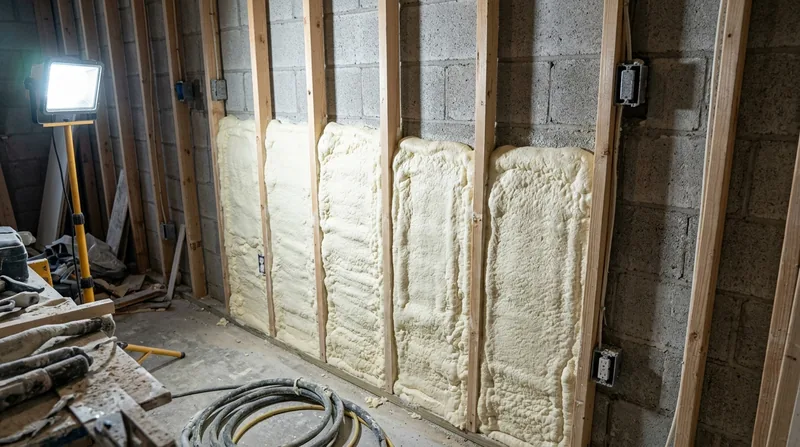




Closed cell spray foam insulation in Orlando addresses the core thermal and moisture challenge that defines this region: hot, humid air that infiltrates attics and block walls year-round, driving cooling costs and creating conditions for moisture damage. Orlando's slab-on-grade homes, mid-century masonry blocks, and frame construction over garages all leak conditioned air through unsealed rim joists, vented attic decks, and porous masonry. Closed cell foam creates a continuous moisture barrier and air seal that fiberglass cannot match, and it performs especially well on the rim joists, block walls, and sealed roof decks that dominate the Orange and Seminole county building stock. We have installed closed cell foam across Orlando, Winter Park, Kissimmee, Sanford, and surrounding areas since 2010, and we approach each job with a clear understanding of what the local climate demands: controlled installation, correct thickness, and a moisture-first mindset. This page explains why closed cell foam works for Orlando homes, how we install it, and what to expect when you call for an estimate.
Why Closed Cell Spray Foam Matters in Orlando's Hot, Humid Climate
Orlando sits in IECC climate zone 2A, which means long, hot summers with high humidity and mild winters. The attic is the weakest thermal point in nearly every home here: vented attic spaces pull in hot, damp air from June through November and well into spring, and that moisture drives inward through the roof deck and into the conditioned space. Block walls in Baldwin Park, Thornton Park, College Park, and Winter Park add another path for heat and humidity penetration, since masonry alone provides little thermal resistance. Rooms over garages and long duct runs toward Lake Nona and Winter Garden push cooling bills higher than the rest of the house because the air seal is broken at the rim joist and the attic above. Closed cell foam stops these leaks cold.
- Closed cell foam blocks moisture infiltration through rim joists, band joists, and block walls where fiberglass fails.
- It cures to a moisture-resistant layer that protects the structure underneath even if humidity spikes in the attic.
- Closed cell achieves an R-value of 6.0 to 6.5 per inch, meaning a 1.5-inch application on a rim joist delivers R-9 to R-10 in a footprint that fiberglass cannot match.
- It seals air leaks at the same time it insulates, eliminating the separate step of caulking and tape that blown-in insulation requires.
These four factors combine to make closed cell foam the standard choice for rim joists, sealed attic decks, and block wall retrofit across the Orlando metro.
Key info: Florida's building code requires a thermal barrier between foam and occupied space. A 15-minute thermal barrier (typically 1.5 inches of drywall or spray-applied coating) is mandatory in attics, rim joists, and walls. We specify this correctly on every estimate, and the building department at your address has the final say on what applies. Always ask your local building official before any foam goes down.
For more context on how sealed attics perform compared to vented ones, see our page on attic spray foam insulation in Orlando.
How We Install Closed Cell Spray Foam in Orlando Homes and Commercial Buildings
Closed cell foam installation starts with a site assessment. We inspect the substrate (rim joist, attic deck, block wall, or roof deck), confirm it is dry and structurally sound, and identify any air leaks that need sealing first. If we find moisture, active leaks, or contamination, we walk away and refer you to the right specialist. Once the substrate is cleared, we set up mechanical ventilation in the work area, spray the foam in controlled passes at the manufacturer-specified ratio and drum temperature, and maintain that ventilation for the full cure window, which runs 24 to 48 hours depending on ambient conditions and foam thickness.
- We pull written estimates with R-value and thickness specifications so you know exactly what you are paying for.
- We rig mechanical ventilation during the spray and cure phases to keep VOC levels safe for re-entry.
- We install the thermal barrier (drywall, intumescent coating, or other code-approved material) as part of the closed cell package when required by your local building code.
- We schedule the job around your occupancy and weather, avoiding rain and temperature swings that affect foam cure.
- We clean up the rig and the work site same day and leave you with a clear re-entry window in writing.
This methodical approach is what separates a professional closed cell installation from a rig-and-run job that leaves you with odor complaints and no one to call.
Example: A Winter Park homeowner with a 1,200 square foot attic deck and a vented soffit had a 40-degree temperature differential between the attic and the living space below. We sealed the rim joist band with 2 inches of closed cell foam (R-12 to R-13), installed a 1.5-inch thermal barrier, and sealed all penetrations and ductwork connections. The attic temperature dropped by 15 degrees in the first week of operation, and the cooling bill fell by 18 percent the following summer.
Learn more about air sealing in Orlando and how it works alongside foam installation.
Closed Cell Spray Foam Installation Methods and Applications
| Application | Description | Best for Orlando |
|---|---|---|
| Rim Joist and Band Joist | 1.5 to 2 inches of closed cell foam sprayed on the band board and rim cavity, creating a continuous air and moisture seal at the foundation line. | Every slab-on-grade home in Orlando, Winter Park, Sanford, and Kissimmee. This is the entry-point job and the highest-return retrofit. |
| Sealed Attic Deck (Unvented) | 2 to 4 inches of closed cell foam sprayed on the underside of the roof deck, turning the attic into a conditioned space and eliminating the vented soffit. | New construction and major attic retrofits in frame homes toward Lake Nona and Winter Garden. Eliminates moisture infiltration through the roof deck. |
| Block Wall Retrofit (Injection Foam) | Closed cell foam injected into the cavity of existing masonry walls without demolition, sealing air leaks and adding thermal resistance. | Mid-century block homes in Baldwin Park, Thornton Park, College Park, and Winter Park where exterior stucco or veneer is in place. |
| Metal Building and Sealed Roof Deck | 3 to 5 inches of closed cell foam sprayed on metal roof decks and walls, preventing condensation and thermal bridging through steel. | Barndominiums, metal buildings, and warehouses across Orange and Lake counties. Closed cell is the only product that stops condensation on metal. |
Closed Cell Spray Foam Insulation Cost in Orlando: What to Expect
Closed cell spray foam is priced by the board foot, which is a square foot of material at one inch thick. The starting rate in the Orlando market is $1.20 per board foot, and the final cost depends on the thickness you need, the area being sprayed, and the difficulty of access. A rim joist band on a typical 2,000 square foot home runs 150 to 200 board feet and costs between $180 and $240 before the thermal barrier. A sealed attic deck of 1,200 square feet at 2.5 inches thick is 3,000 board feet and runs $3,600 to $4,200, again before the thermal barrier and any structural repairs. Block wall injection is measured on site because the cavity depth varies, and a 500 square foot wall section at 1.5 inches typically costs $900 to $1,200.
Three factors move the price up from the base rate: difficult access (attics with limited entry, crawl spaces under 3 feet tall, or areas requiring scaffolding), the need to remove old insulation first, and structural repairs or moisture remediation before foam goes down. Always get 2 to 3 written estimates with R-value and thickness spelled out, so you can compare apples to apples. If an estimate has no R-value and no thickness, no inspection date, and a price far below market, that is a warning sign. Visit our full pricing page for detailed breakdowns by application.
What to Look for When Hiring a Closed Cell Spray Foam Contractor Near Me in Orlando
Hiring the right spray foam contractor is the difference between a silent, durable installation and a job that smells bad, leaves gaps, or fails within a few years. When you are shopping for a spray foam insulation contractor near Orlando, ask these questions and verify the answers yourself. First, confirm the contractor is fully insured and can show you a current certificate of insurance naming you as an additional insured. Second, ask for written estimates with R-value, thickness in inches, and the total board feet being sprayed. Third, call at least two references from jobs in the last 12 months in your area (Winter Park, Sanford, Kissimmee, or wherever you are). Fourth, ask what the re-entry window is and whether mechanical ventilation will run during the spray and cure. Fifth, understand what permits are required at your address by calling the local building department before you book. Sixth, if you are in an HOA community, confirm that the architectural review board has signed off on the work (rarely an issue for interior insulation, but always verify).
- Ask to see the insurance certificate and verify it covers spray foam installation and that the policy is active.
- Request a written estimate with R-value per inch, total thickness, and board feet, so you know what you are paying for.
- Call the local building department and ask what permits and thermal barrier requirements apply to your specific address and project type.
- Check references from completed jobs in your neighborhood within the last year, and ask about odor, cure time, and cleanup.
- Confirm that the contractor will use mechanical ventilation during spray and cure and will provide a written re-entry window of 24 to 48 hours.
If a contractor promises immediate re-entry, refuses to provide references, or cannot explain the R-value and thermal barrier requirement for your job, move on. Contact us for a free, written estimate and we will walk you through every step of the process.
Closed Cell Spray Foam Insulation in Orlando: Pricing Guide
| Service | Price | Details |
|---|---|---|
| Rim Joist and Band Joist Seal | Starting at $1.20/board ft | Typical 150 to 200 board feet for a 2,000 square foot home, plus thermal barrier and air sealing around the foundation perimeter |
| Sealed Attic Deck (Unvented) | Starting at $1.20/board ft | 2 to 4 inches of closed cell foam on roof deck, measured on site; typical 1,200 sq ft attic runs 2,400 to 4,800 board feet plus thermal barrier |
| Block Wall Injection Foam | Starting at $1.20/board ft | Closed cell foam injected into masonry cavities without demolition; cavity depth and wall area measured on site, typically 500 to 1,000 board feet per wall section |
| Metal Building and Sealed Roof Deck | Starting at $1.20/board ft | 3 to 5 inches on metal surfaces to prevent condensation; square footage and access difficulty determine final board foot count and labor |
| Insulation Removal and Replacement | On estimate | If old insulation must be removed before foam, cost depends on material type, volume, and disposal; quoted separately and added to foam cost |
| Free Written Estimate | No charge | Response within 24 hours at (689) 219-8153; includes R-value, thickness, board feet, thermal barrier requirement, and permit guidance for your address |
Indicative pricing, the exact cost depends on square footage, finish, and site access. Free personalized estimate within 24h at (689) 219-8153.


