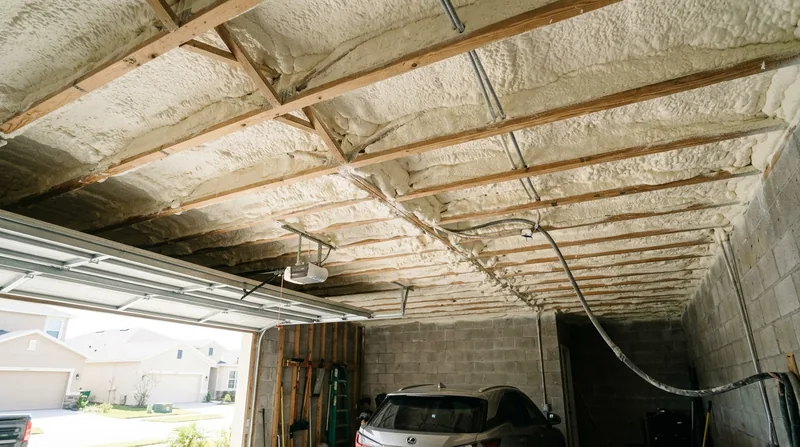




Rooms over garages in Orlando's two-story subdivisions run significantly hotter than the rest of the house, especially in newer developments near Lake Nona and Winter Garden where frame construction stacks living space directly above an uninsulated garage cavity. The garage itself acts as a thermal sponge, absorbing heat from the concrete slab and the sun-facing walls, then radiating that warmth upward through the ceiling into the bedroom or bonus room above. Garage spray foam insulation stops that heat transfer at the source by sealing the garage walls and ceiling with closed-cell or open-cell foam, cutting the temperature differential and reducing the cooling load on your air conditioning system. In Orlando's hot, humid climate where air conditioning runs most of the year, that difference translates directly to lower energy bills and more consistent comfort. We've been installing spray foam insulation across Greater Orlando since 2010, and garage ceiling and wall foam is one of the most cost-effective upgrades we perform for homeowners frustrated with hot upstairs rooms.
Why Garage Spray Foam Insulation Matters in Orlando's Heat and Humidity
Orlando sits in IECC climate zone 2A, meaning hot summers with high humidity and cooling demand that runs from April through November. A typical garage in an Orlando subdivision has a concrete slab that absorbs heat all day, exterior walls that face the afternoon sun, and an overhead door that sees temperature swings of 20 to 30 degrees between morning and late afternoon. Without insulation, that garage ceiling becomes a conduit for heat rising into the living space above. Humidity also plays a role: the garage air is often more humid than the conditioned house air, and that moisture-laden air naturally moves upward through any gap or unsealed penetration in the ceiling plane.
- We spray closed-cell or open-cell foam directly onto the garage ceiling and walls to create an air barrier that stops heat and humidity transfer in both directions.
- Foam insulation on the garage walls reduces radiant heat gain from the sun-facing surfaces, especially important on west and south-facing garages in subdivisions like Lake Nona and Winter Garden.
- The air seal around electrical boxes, HVAC penetrations, and rim joists prevents stratified air from the garage from rising into the room above, which fiberglass batts or blown-in insulation alone cannot accomplish.
- A properly insulated garage ceiling maintains a more stable temperature in the room above, reducing the workload on your air conditioning system during peak cooling hours.
The result is measurable comfort and efficiency: homeowners report that rooms over garages no longer feel like a separate climate zone, and the upstairs cooling bill drops noticeably when garage insulation is paired with attic sealing and duct work in the attic.
Key info: Orlando's building code, governed by the City of Orlando and Orange County depending on your address, requires thermal and ignition barriers on spray foam insulation in garage spaces. We follow the code that applies to your specific location and coordinate with your local building department to ensure compliance. Always verify permit requirements with your city or county before work begins.
For more detail on how spray foam addresses moisture and humidity in attic spaces, see our page on attic spray foam insulation in Orlando, where the same principles of air sealing apply in a different context.
How We Install Garage Spray Foam Insulation in Orlando
The job starts with a site visit where we assess the garage ceiling height, the presence of electrical wiring, HVAC ducts, or plumbing in the ceiling cavity, and the condition of the drywall or substrate. We then measure the square footage of ceiling and walls to be sprayed and determine the best foam type (closed-cell for maximum R-value and air barrier performance, or open-cell for a lower cost option in non-humid applications). The crew arrives with equipment, sets up mechanical ventilation to manage fumes during application, and begins spraying in controlled passes, building thickness gradually to reach the specified R-value.
- We inspect the garage ceiling and walls for moisture, active leaks, or damage, and we do not spray over a wet or contaminated substrate.
- We install temporary mechanical ventilation in the garage to exhaust isocyanate vapors during application and for at least 24 to 48 hours after spraying stops.
- We spray foam in multiple thin passes rather than one thick pass, ensuring proper chemical ratio, drum temperature, and even coverage across the entire surface.
- We apply thermal and ignition barriers per code, typically a fire-rated coating or drywall, depending on the foam type and your local building requirements.
- We schedule re-entry after the cure window closes, typically 24 to 48 hours, and we provide written guidance on ventilation and odor management.
A typical garage ceiling foam job in a Winter Park or Altamonte Springs home takes one to two days from start to finish, including barrier application and cleanup.
Example: A homeowner in Winter Garden with a 400-square-foot garage ceiling and walls brings the crew in on a Monday morning. We set up ventilation, spray 2 inches of closed-cell foam to R-14, apply the thermal barrier, and finish by afternoon. The family opens windows and runs the ventilation fan overnight, and the garage is ready for normal use by Tuesday evening. The room above stays noticeably cooler for the rest of the summer.
See our full process and air sealing approach on the air sealing page for more on how we seal the building envelope around garage spaces and other key zones.
Garage Spray Foam Methods and Foam Types
| Approach | Description | Best for |
|---|---|---|
| Closed-Cell Spray Foam | Dense, rigid foam with high R-value per inch (R-6 to R-7), excellent air barrier, resists moisture intrusion. | Garage ceilings and walls where maximum thermal performance and humidity control are priorities, especially in humid Orlando climate. |
| Open-Cell Spray Foam | Softer, lower-density foam with moderate R-value (R-3.5 per inch), good air barrier, lower cost per board foot. | Garage spaces where budget is a concern and the environment is not chronically humid; less common in Orlando but used for top-up jobs. |
| Garage Ceiling Only | Foam applied to the overhead surface, typically 2 to 3 inches thick, creating an insulated barrier between garage and room above. | Homes where the garage walls are already insulated or where budget is limited; most common retrofit in Orlando subdivisions. |
| Ceiling and Walls Combined | Foam on the overhead and exterior walls, sealing the entire garage envelope for maximum thermal and humidity control. | Garages with west or south exposure, or homes where the upstairs room is consistently hot despite ceiling insulation alone. |
Closed-cell foam is the most common choice for Orlando garage work because it delivers the highest R-value per inch, provides a true air barrier, and resists the moisture and humidity that define our climate. Open-cell foam is a lower-cost alternative but is less effective in humid conditions.
Garage Spray Foam Insulation Cost in Orlando: What to Expect
Garage spray foam insulation in Orlando typically starts at $1,200 for a basic ceiling-only job on a smaller garage, and increases based on the square footage of ceiling and walls, the foam type chosen (closed-cell costs more per board foot than open-cell), and the thickness required to meet your R-value target. A 400-square-foot garage ceiling with 2 inches of closed-cell foam generally falls in the $1,500 to $2,500 range, depending on access, the condition of the existing substrate, and whether walls are included. If the garage has vaulted ceilings, sloped roofs, or complex geometry, the cost rises because the crew spends more time and material on coverage.
Several factors move the price up or down. Access to the garage matters: if the space is cluttered or parking prevents equipment placement, setup takes longer. The substrate condition also plays a role: if drywall is damaged or wet, we repair or replace it before spraying. If you choose closed-cell over open-cell, expect to pay more per board foot, but you gain superior moisture resistance and a higher R-value. Thermal and ignition barrier materials, required by code in garages, add cost but are non-negotiable.
We always provide a written estimate with R-value, foam thickness, square footage, and material cost broken out separately, so you know exactly what you are paying for. Getting two or three estimates from different contractors is smart practice: compare not just price but the R-value specified, the barrier type, and the warranty terms offered. The cheapest estimate is often a sign that corners are being cut, whether that is a missing air seal, no mechanical ventilation during cure, or an unverified insurance claim.
See our full pricing page for detailed breakdowns and to understand the factors that move cost up or down. Call us at (689) 219-8153 for a free, no-obligation estimate tailored to your garage.
Garage Spray Foam Insulation Near Me: What Orlando Homeowners Should Know When Hiring
When you are looking for a spray foam contractor in Orlando, Winter Park, Altamonte Springs, or any of the surrounding communities, there are several things to verify before you sign a contract. Start by asking whether the contractor carries liability and property damage insurance and request a certificate of insurance naming you as an additional insured. Do not hire based on price alone: a contractor quoting significantly below market often cuts corners on chemical ratio, ventilation, or barrier installation, all of which create problems later. Check references from previous garage jobs in your area, and ask those homeowners whether they experienced odor issues, whether the room above stayed cooler, and whether the contractor was responsive if questions arose after the work.
- Verify that the contractor provides a written estimate with R-value, foam thickness in inches, square footage, and a breakdown of material and labor costs.
- Ask whether the contractor will pull any permits required by your city or county, and understand that permit requirements vary between Orlando, Winter Garden, Kissimmee, and other municipalities, so verify with your local building department what applies at your address.
- Confirm that the contractor uses mechanical ventilation during application and for the full cure window, and ask about the re-entry timeline, which should be 24 to 48 hours minimum.
- If your home is in an HOA community, check whether architectural approval is required for garage work (usually not for insulation, but always verify with your HOA before booking).
- Ask whether the contractor offers a workmanship warranty and for how long; a one- to three-year warranty on installation quality is standard in this trade.
A local, independent spray foam contractor with a physical address in Orlando and verifiable insurance is a safer choice than a rig-and-run operation from out of state or a franchise that routes calls to a distant call center. You want someone you can reach if the smell lingers longer than expected or if you have questions about the foam performance.
Ready to get started? Contact us for a free estimate, or call (689) 219-8153 to discuss your garage and get a concrete price within 24 hours. We serve Orlando, Winter Park, Winter Garden, Kissimmee, Sanford, Apopka, and all of Orange, Seminole, and Lake counties. If you are also interested in insulating your attic or sealing air leaks elsewhere in the house, ask about bundled pricing on multiple zones.
Garage Spray Foam Insulation in Orlando: Pricing Guide
| Service | Price | Details |
|---|---|---|
| Garage ceiling only, basic | Starting at $1,200 | Closed-cell or open-cell foam on overhead surface, 2-inch depth, includes thermal barrier application |
| Garage ceiling and walls combined | Starting at $1,800 | Foam on overhead and exterior walls, 2 to 3 inches depth, full envelope sealing, higher R-value performance |
| Large garage or complex geometry | On estimate | Vaulted ceilings, sloped roofs, multiple zones, or substrate repair required; site assessment determines final price |
| Travel and mobilization | Included | No separate mileage or call-out fee within Orlando and surrounding service area counties |
| Free estimate | Free | Written estimate with R-value and thickness specs, response within 24 hours, no obligation to book |
Indicative pricing, the exact cost depends on square footage, finish, and site access. Free personalized estimate within 24h at (689) 219-8153.


