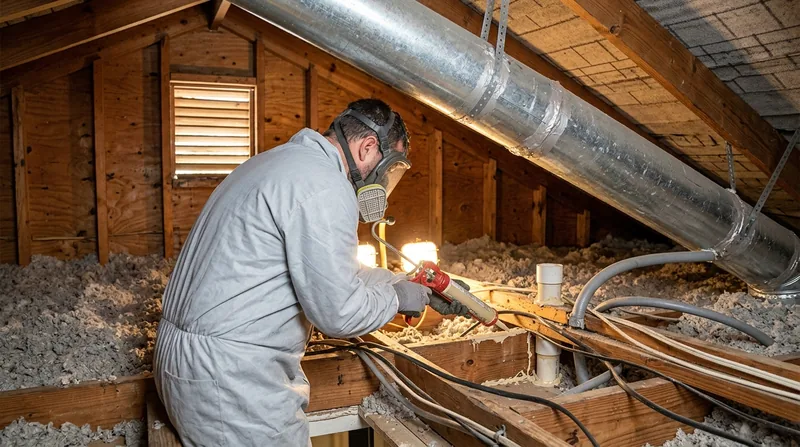




Air sealing in Orlando stops hot, humid air from leaking through masonry walls and vented attics year-round. Orlando's climate zone 2A keeps moisture pressure high nearly every month, and older block homes around Lake Eola and College Park pull in damp air through every crack in the wall and attic plane. Newer frame construction over garages in Winter Garden and Lake Nona routes conditioned air straight into unconditioned spaces, driving cooling costs up and humidity deeper into the building envelope. Sealing penetrations, rim joists, and the attic-to-conditioned-space boundary cuts the stack effect that pulls moisture inward when the AC is running. We identify air leaks with blower-door diagnostics and seal them with spray foam and caulk, stopping the cycle before it reaches your ductwork and living spaces. Learn more about how attic spray foam insulation complements air sealing to lock in performance.
Why Air Sealing Matters in Orlando's Hot, Humid Climate
Orlando sits in a hot and humid subtropical zone where the stack effect works against you nine months a year. Vented attics pull in outdoor air as warm air inside rises and escapes through the roof deck, and that incoming air is saturated with moisture. Block walls in older neighborhoods absorb and transmit that humidity directly into the wall cavity, and metal buildings scattered across Orange County develop condensation on the underside of the roof when outdoor air meets cold ductwork. The problem is not seasonal like a northern winter. It is constant, driven by the daily temperature swing and the humidity that never drops below 60 percent even at night.
- Vented attics pull humid air inward through the ceiling plane and soffit vents whenever the house is cooled.
- Block walls and masonry mortar joints leak air and moisture directly into the living space and wall cavities.
- Rooms over garages and long attic runs above ductwork see temperature swings that drive moisture into insulation and framing.
- Metal buildings and warehouses develop condensation on steel roof decks when warm, moist air inside meets cold exterior air pressure.
- Air leaks around electrical penetrations, HVAC returns, and rim joists are the primary path for moisture ingress in both block and frame construction.
Sealing these leaks is the first step to controlling humidity and cutting cooling load. Every cubic foot of outdoor air that enters the conditioned space must be cooled and dehumidified by your AC system, and in Orlando that cost compounds across the entire cooling season.
Key info: A single 1-inch crack running 10 feet along a rim joist or attic band board leaks as much air as leaving a window cracked open all day. Sealing that one path can cut infiltration by 5 to 15 percent in a typical Orlando home, depending on the total air leakage of the structure. The Florida Building Code requires air sealing in new construction, and retroactive sealing is the most cost-effective energy upgrade you can make to an existing home.
For permitting questions, refer to your local Orlando Building Services office to confirm what air sealing work requires inspection at your address.
How We Perform Air Sealing: From Diagnosis to Sealed Penetrations
Air sealing is not a one-size job. We start by finding where air is actually leaking, then choose the right material and technique for each penetration. Spray foam works best on large voids and irregular gaps in attics and rim joists. Caulk and sealant handle smaller cracks and seams. The key is identifying every leak before you seal it, because guessing wastes material and leaves paths open. We use blower-door testing and thermal imaging to map air flow patterns, then seal systematically from the attic down to the rim joist and band board, and around every electrical, plumbing, and HVAC penetration.
- We perform a blower-door test or visual inspection to locate active air leaks in the attic, rim joists, and conditioned walls.
- We identify the size and shape of each leak and select spray foam, caulk, or foam sealant as appropriate for that opening.
- We prepare the substrate by removing debris and ensuring it is dry before applying any sealant or foam.
- We apply closed-cell or open-cell spray foam to large voids in rim joists, band boards, and attic bypasses, maintaining proper thickness and coverage per the manufacturer specification.
- We caulk or foam-seal smaller cracks, electrical chases, and plumbing penetrations with low-VOC, paintable sealant rated for the substrate temperature.
- We allow proper cure time before allowing re-entry, typically 24 to 48 hours for spray foam, and we provide ventilation during cure to manage any odor.
A typical air sealing job in an Orlando attic takes one to two days depending on the size of the space and the number of penetrations. Rim joist and band board sealing on a single-story home usually runs four to six hours and is often combined with other insulation work.
Local example: A mid-century block home in Winter Park with an open attic above a vented soffit system typically has 40 to 80 linear feet of rim board, plus 15 to 25 electrical and plumbing penetrations. Sealing all of those paths with closed-cell foam and caulk stops the stack effect and reduces attic air temperature by 5 to 10 degrees on a typical summer day, which cuts the cooling load on the rooms below. A home in Apopka with rooms over a garage sees even greater benefit because the garage is unconditioned and pulls hot air upward through the rim joist.
See how crawl space spray foam insulation pairs with air sealing to seal the entire thermal boundary.
Air Sealing Methods and Materials
| Approach | Description | Best for |
|---|---|---|
| Closed-Cell Spray Foam | High-density foam (2 to 3 lbs/cu ft) that creates an air and vapor barrier in a single pass. Requires a thermal barrier and ignition barrier per code. | Rim joists, band boards, large attic voids, and crawl space rim beams where vapor control and high R-value per inch are required. |
| Open-Cell Spray Foam | Low-density foam (0.5 to 1 lb/cu ft) that seals air but allows vapor transmission. Less rigid than closed-cell and easier to cut and trim. | Attic penetrations, interior walls, and sound dampening where vapor permeability is beneficial and structural support is not required. |
| Caulk and Sealant | Low-VOC, paintable, polyurethane or silicone-based sealant for cracks, seams, and small penetrations. Paintable and durable over decades. | Electrical outlet penetrations, plumbing chases, drywall cracks, and small gaps around ductwork where spray foam is overkill. |
| Foam Sealant Backer Rod | Flexible foam rod inserted into gaps before caulking, reducing sealant volume and improving flexibility in wood-frame joints. | Rim joist and band board seams, roof-to-wall transitions, and any gap wider than 0.5 inches but narrower than 2 inches. |
Air Sealing Cost in Orlando: What to Expect
Air sealing in Orlando starts at around $650 for a basic attic or rim joist sealing job, but the final cost depends on how much air is leaking and how many penetrations need to be sealed. A single-story home with a modest attic and accessible rim board might run $800 to $1,200. A two-story home with rooms over a garage, long attic runs, and multiple HVAC chases can reach $1,500 to $2,500. The factors that move cost are the square footage of attic or rim area, the number of electrical and plumbing penetrations, accessibility (flat roof versus steep pitch, easy access versus crawling through insulation), and whether spray foam or caulk is the right tool for each leak.
Getting two or three estimates from contractors who actually perform blower-door testing or thermal imaging is the only way to know if the price is fair. A contractor who quotes a price over the phone without visiting your home is not diagnosing the problem. We provide a written estimate that specifies the method (closed-cell foam, open-cell foam, or caulk), the linear feet or square footage of coverage, R-value and thickness where spray foam is used, and the expected timeline. Travel is included across Orlando and surrounding areas, and the estimate itself is free.
See our full pricing overview for more detail on cost drivers and typical job ranges.
What to Look for When Hiring an Air Sealing Contractor Near Me in Orlando
Hiring the right contractor for air sealing is as important as the work itself. A poor air sealing job leaves leaks sealed halfway, uses the wrong material for the substrate, or applies spray foam without proper ventilation, leaving odor and off-gassing that lasts for weeks. The best contractors diagnose the problem first, explain what they find, and tell you when the cheaper option (caulk instead of foam) is the right one. Here is what to verify before you book.
- Confirm the contractor is fully insured and can provide a current certificate of insurance naming your address as an additional insured.
- Ask for references from three or more jobs completed in the last two years and call at least one to ask about odor, timeline, and cleanup.
- Request a written estimate that includes the method, coverage area, material specifications, and expected timeline, not a phone quote or a price per square foot.
- Verify that the contractor understands local permitting for air sealing in your city or county, and confirm whether an inspection is required at your address.
- Check that the contractor uses proper ventilation and mechanical extraction during spray foam cure, and provides a realistic re-entry window of 24 to 48 hours.
- Ask whether the contractor has experience with your specific building type (block, frame, metal building) and can explain why closed-cell or open-cell foam is appropriate for your attic or rim joist.
The contractor should be able to answer every question without hesitation and should never pressure you to decide on the spot. A local shop with a local address and local phone number is easier to reach if questions arise after the job is done than an out-of-state crew that moves on to the next job the next day.
Call us at (689) 219-8153 for a free estimate and to discuss your specific air sealing needs. We serve Orlando, Winter Park, Kissimmee, Sanford, Apopka, and the surrounding counties, and we are happy to answer any questions about method, cost, or timeline. Contact us online to request an estimate or to schedule a time for us to visit your home.
Air Sealing in Orlando: Pricing Guide
| Service | Price | Details |
|---|---|---|
| Attic Air Sealing | Starting at $650 | Sealing penetrations and rim board in attics up to 1,000 sq ft with spray foam and caulk, including blower-door or visual assessment |
| Rim Joist and Band Board Sealing | Starting at $750 | Closed-cell or open-cell foam sealing of rim and band joists on single-story homes, typically 40 to 80 linear feet of board |
| Multi-Story or Complex Sealing | Starting at $1,200 | Rooms over garages, long attic runs, multiple HVAC chases, or two-story homes requiring comprehensive attic and rim joist sealing |
| Blower-Door Test and Diagnostic | Starting at $300 | Standalone diagnostic to identify air leaks before sealing work, results used to scope and price the sealing job accurately |
| Travel | Included | No separate mileage fee or call-out charge for jobs within Orlando and surrounding Greater Orlando area |
| Estimate | Free | Written estimate with method, coverage area, and timeline provided within 24 hours, no obligation to book the work |
Indicative pricing, the exact cost depends on square footage, finish, and site access. Free personalized estimate within 24h at (689) 219-8153.


