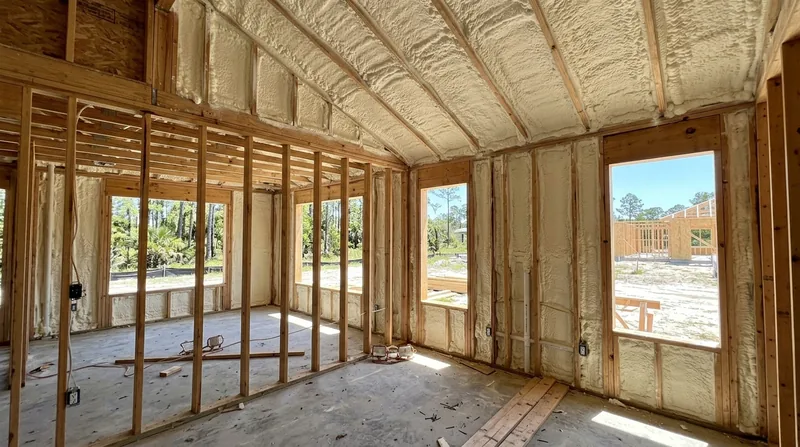




Commercial and new construction spray foam insulation in Orlando seals the building envelope before drywall closes, stopping air leakage and moisture infiltration at the source. New construction across Orange and Seminole counties gets one chance to get the envelope right, and spray foam applied to walls and roof decks during the framing stage prevents the hot, humid air that dominates the region from ever entering the cavity. Orlando sits in IECC climate zone 2A with long, moisture-laden summers and nearly constant humidity. Older mid-century homes in College Park and Winter Park carry masonry walls and vented attics that were never sealed tight, while newer subdivisions toward Lake Nona and Winter Garden stack two-story frame construction with rooms over garages. The attic is the weak point across the metro: vented spaces pull in hot, damp air most of the year, and moisture drives inward through the roof deck rather than out. New construction that seals the roof deck with spray foam before framing closes eliminates that failure mode before it starts. We spray foam walls and roof decks during the build, apply the correct thermal barrier per code, and hand off a tight envelope to the HVAC contractor.
Why Spray Foam Sealing Matters in New Construction Across Orlando
New construction in Orlando and the surrounding counties competes in a market where cooling costs and humidity control define buyer comfort and resale value. A building envelope sealed with spray foam during framing eliminates the air leakage paths that vented attics and block walls create. The moisture-driven failure mode that dominates Central Florida requires the roof deck and exterior walls to be continuous and airtight, not vented and porous. Spray foam applied before drywall closes in the work gives the builder a finished, inspectable envelope with no hidden voids or missed cavities.
- We spray closed cell foam on roof decks to create a continuous thermal and air barrier that stops moisture infiltration before it reaches the attic space.
- We seal wall cavities during framing so that exterior air and humidity cannot bypass insulation through gaps, cracks, or settling voids.
- We apply the correct thermal barrier thickness per code so that drywall and trim can be installed immediately without re-entry delays.
- We coordinate with the builder's schedule so that spray foam is applied after rough electrical and plumbing but before any drywall delivery.
- We inspect and document all work with written R-value and thickness specifications so that the builder and buyer have proof of what was installed.
Sealed roof decks and continuous wall insulation are the only reliable defense against the hot, damp air that drives cooling costs and moisture problems in Central Florida new construction.
Local example: A new two-story frame home in Winter Garden with a room over the garage and a long vented attic run loses 30 to 40 percent of its cooling to air leakage through the attic and into the wall cavities. Spray foam on the roof deck and in the exterior walls before drywall closes eliminates that leakage path and delivers a tight envelope that the HVAC contractor can balance and commission correctly.
For permit and code requirements in your jurisdiction, contact your local building department. Orange County Government and the city building offices in Winter Park, Kissimmee, and Sanford each govern spray foam installations and thermal barrier requirements within their jurisdictions.
How We Install Spray Foam in New Construction: The Process
New construction spray foam installation follows the builder's schedule and the sequence of the work. We arrive after rough-in trades have finished and before drywall is delivered. We assess the roof deck, exterior walls, and any special cavities such as rim joists or band joists. We confirm the foam specification (closed cell or open cell), the R-value target, and the thermal barrier requirement with the builder and the code. We set up mechanical ventilation to exhaust fumes during the spray and cure period. We apply foam in controlled passes, maintaining the correct drum temperature and material ratio, and we document thickness and coverage on site.
- We inspect all substrate surfaces for moisture, contamination, or damage before spraying, and we defer the job if conditions are not right.
- We spray roof decks in multiple passes if thickness exceeds the manufacturer's single-pass limit, allowing cure time between passes.
- We install a thermal barrier (drywall, intumescent paint, or other approved material) to the foam surface within the time frame required by code.
- We provide a written estimate with R-value and thickness specifications so the builder has proof of what was ordered and what was installed.
- We observe a re-entry window of 24 to 48 hours after the final pass before drywall, trim, or mechanical work proceeds in the sealed space.
Correct installation during the framing stage is the only way to guarantee a sealed envelope that will perform for the life of the building.
Local example: A new metal building warehouse in Sanford requires closed cell foam on the roof deck to prevent condensation on the steel purlins and to meet the energy code. We spray the deck during the framing phase, apply a fire-rated thermal barrier, and hand off a tight, dry roof structure to the electrical and HVAC trades. The builder avoids moisture and mold problems during construction and delivers a tight envelope to the tenant.
Learn more about closed cell spray foam insulation and how it controls moisture in metal buildings and sealed roof decks.
Spray Foam Methods for New Construction
| Approach | Description | Best for |
|---|---|---|
| Closed Cell Roof Deck Spray | High-density foam applied to the underside of the roof sheathing in multiple passes, creating a continuous thermal and air barrier with R-values from 6 to 7 per inch. | Metal buildings, warehouses, residential sealed attics, and any application where condensation control and airtightness are required. |
| Closed Cell Wall Cavity Fill | Foam sprayed into exterior wall cavities during framing to fill voids and seal air leakage paths, with R-values from 3.5 to 3.8 per inch in frame walls. | New residential and light commercial frame construction where exterior air infiltration and moisture control drive the insulation choice. |
| Open Cell Wall and Attic Spray | Lower-density foam applied to walls and attic spaces for sound dampening and thermal control, with R-values from 3.5 to 3.8 per inch and vapor permeability for humidity management. | Interior walls where sound control is valued, and attics where vapor permeability and cost are balanced against thermal performance. |
| Rim and Band Joist Sealing | Closed cell foam applied to rim joists, band joists, and the perimeter of the building frame to seal the transition between the foundation and the floor framing. | All new construction with concrete slab or crawl space foundations, where air leakage at the rim joist drives heating and cooling losses. |
| Garage Ceiling and Wall Spray | Foam applied to garage ceilings and exterior walls in new construction to separate conditioned living space from unconditioned garage, reducing thermal transfer and air leakage. | Two-story homes and townhouses with rooms or living space above garages, where temperature control and odor isolation are required. |
Commercial and New Construction Spray Foam Cost in Orlando: What to Expect
Spray foam costs in new construction depend on the area being sealed, the foam type (closed cell or open cell), the thickness required by code, and the complexity of the roof or wall geometry. Closed cell foam costs more per board foot than open cell but delivers higher R-value and moisture control, making it the standard for roof decks and metal buildings in Florida. Open cell foam is less expensive and suitable for interior walls and attics where vapor permeability is acceptable. A free commercial estimate from Orlando Spray Foam Insulation is the only way to get an accurate price for your building, because board footage, access, and substrate condition vary widely from job to job.
Factors that move the estimate up or down include the total square footage of the roof deck or wall cavity, the R-value specification required by the energy code for your address, the number of passes required to reach that thickness, and whether the substrate is clean, dry, and ready to spray or requires preparation. A builder spraying a simple rectangular roof deck on a warehouse will pay less per board foot than a residential project with a complex roof line, dormers, and multiple wall cavities. Travel within Orlando and the surrounding service areas is included in our estimate and billing, with no separate mileage charge.
Call us at (689) 219-8153 for a free, no-obligation commercial estimate. We respond within 24 hours and provide written R-value and thickness specifications so you know exactly what you are paying for. See our full pricing overview for more detail on how we structure estimates and what drives the final cost.
What to Look for When Hiring a Spray Foam Contractor Near Me in Orlando
Hiring a spray foam contractor for new construction requires verification of insurance, understanding of local code and thermal barrier requirements, and confidence that the work will be installed correctly on the first pass. The spray foam trade has rig-and-run crews from out of state that spray a job in an afternoon and disappear when the smell does not go away, and it also has national franchises that may not understand local moisture and code requirements. A local, independent spray foam shop with a local address and local plates is positioned to deliver honest guidance and to stand behind the work when the builder or buyer calls back.
- Verify that the contractor is fully insured with a current certificate of insurance naming your builder or development company as an additional insured.
- Ask for written estimates with R-value and thickness specifications so you know exactly what foam type, coverage, and cost you are approving.
- Confirm that the contractor understands the thermal barrier requirement for your jurisdiction and will apply the correct material within the correct timeframe.
- Request references from recent new construction projects in your area and call those builders to ask about quality, schedule adherence, and any issues during or after the spray.
- Verify that the contractor will use mechanical ventilation during the spray and cure period and will observe a re-entry window before drywall installation.
- Confirm that the contractor coordinates with your builder's schedule and does not hold up the framing or drywall trades with delays or rework.
Contact Orlando Spray Foam Insulation at (689) 219-8153 or visit our contact page to request a free estimate and to ask any questions about how we work with builders and developers in Orlando and the surrounding counties. We have been in business since 2010 and understand the code, the climate, and the schedule demands of new construction in Central Florida.
Commercial & New Construction Spray Foam in Orlando: Pricing Guide
| Service | Price | Details |
|---|---|---|
| Commercial estimate (roof deck, wall cavity, or metal building) | Free | Written R-value and thickness specifications included, response within 24 hours, no obligation to book |
| Closed cell roof deck spray (per board foot) | Starting at $1.50 | Includes material, labor, mechanical ventilation, and thermal barrier application; price varies by thickness, access, and substrate condition |
| Closed cell wall cavity fill (per board foot) | Starting at $1.25 | Exterior walls during framing, includes all passes and thermal barrier; complexity and cavity geometry affect final cost |
| Open cell spray (per board foot) | Starting at $0.85 | Interior walls, attics, and sound-dampening applications; lower cost than closed cell with comparable R-value per inch |
| Travel and mobilization | Included | No separate mileage or call-out fee within Orlando and surrounding service areas |
| Large-scale or complex new construction project | On estimate | Multi-building developments, metal structures, and custom geometry require on-site assessment before pricing |
Indicative pricing, the exact cost depends on square footage, finish, and site access. Free personalized estimate within 24h at (689) 219-8153.


